Winterizing your compost bin: keep it cooking or freeze-and-hold
Compost guides get vague exactly when the weather gets serious. Here's the honest version: you have two real strategies for winter, and most guides only describe one — while contradicting each other on whether to turn the pile. Pick the strategy that fits your winters and your energy, run the fall harvest first either way, and the bin will wake up productive in spring.
Two strategies, one honest choice
Keep-it-active: insulate the bin, keep feeding it, and try to maintain some decomposition through winter. Best for milder winters and bigger piles. Freeze-and-hold: harvest the bin before freeze-up, then let the winter's additions freeze and wait — they thaw into active composting in spring. Best for small bins, harsh winters, or gardeners who want the lowest-effort routine. The freeze-and-hold cycle takes roughly 3–4 hours of work per year, most of it in this one fall session.
Step 1: the fall harvest (do this before freeze-up, either strategy)
- Scoop the unfinished top off — anything visibly un-composted comes off the top of the pile and gets set aside in a pile or bucket.
- Empty the finished compost from the bottom. It doesn't have to be perfect — mostly-composted material is fine. Dig it into your garden beds or mulch your flower beds with it; it keeps maturing there through fall and spring.
- Put the unfinished material back in. Return what you set aside to the bottom of the now-mostly-empty bin.
- Stockpile browns. Bag extra fall leaves now — they're your carbon supply all winter, and you can't collect them in January.
Step 2: keep-it-active — insulate and feed
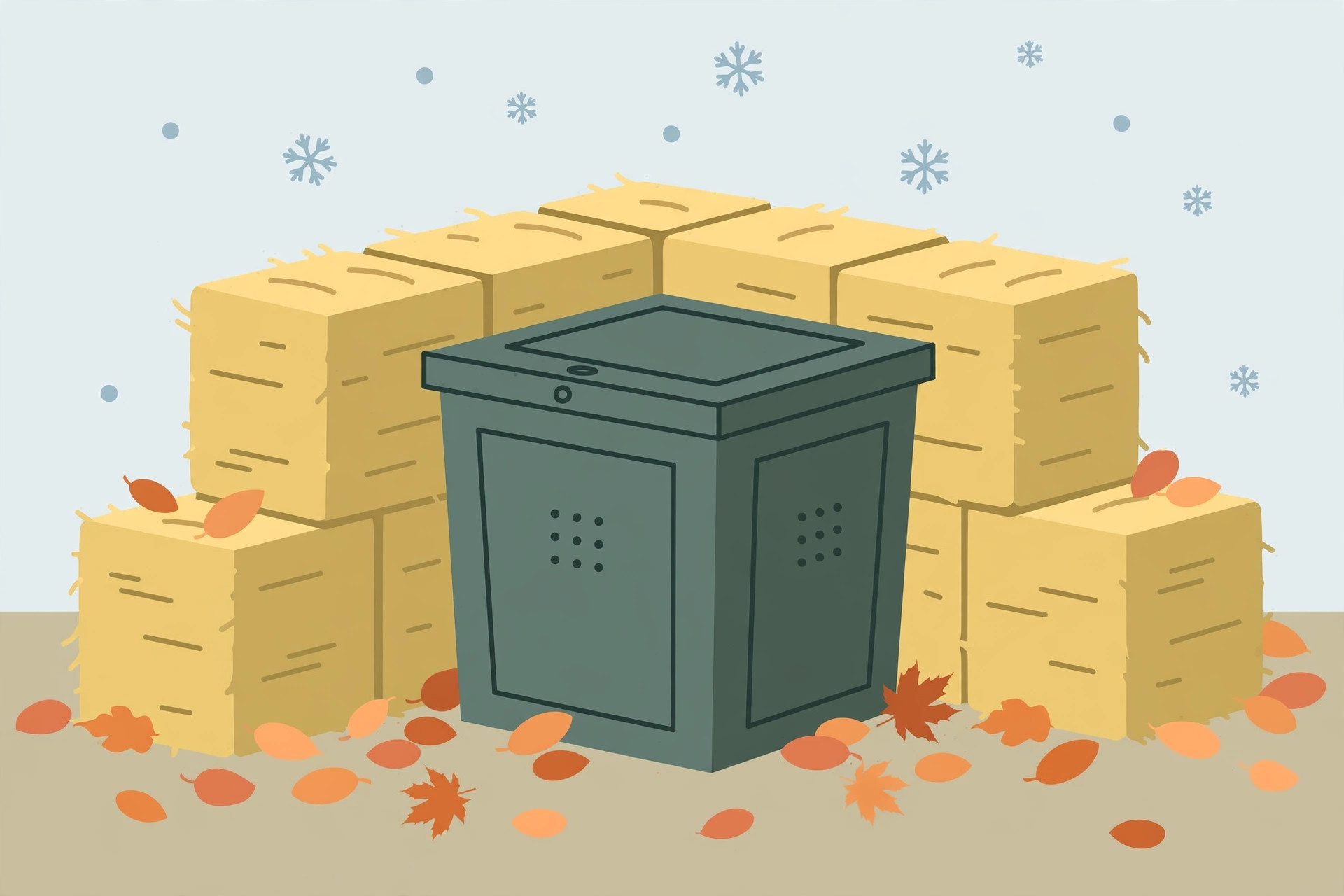
- Insulate the outside. Stack straw bales, bags of leaves, or even old carpet around and over the bin to hold in the microbial heat. The pile needs to be at least about 1 cubic foot to hold any internal warmth.
- Face it to the sun. If the bin can be moved, position it facing south — even weak winter sun helps. Bins tucked behind garages and fences are the first to cool down in fall and the last to warm up in spring.
- Keep the lid on. An open bin fills with snow in winter, leaving you nowhere to put anything — and too much water hinders the microbes.
- Feed the middle, not the top. Dig each new batch of kitchen scraps into the center of the pile rather than dumping it on top, so the fresh greens get the best chance to heat up. Coffee grounds are a strong winter addition — they heat a pile fast.
- Chop everything small. Winter decomposition is slow, so cut kitchen scraps into small pieces and keep a good greens-to-browns balance.
Step 2-alt: freeze-and-hold — the low-effort winter routine
- Keep the cover on the bin so snow stays out.
- Keep adding greens and browns all winter. They'll freeze instead of composting — that's expected, not a failure.
- Don't open or fuss with the bin in deep cold. Come spring, everything thaws and the volume drops fast, leaving you room to resume normal composting.
The turn-vs-don't-turn answer
Two guides give opposite advice — turn regularly in fall, don't turn in winter — and both are right, for their season. Turn the pile through autumn while temperatures are still mild; it introduces oxygen and keeps things cooking. Once the cold settles in, stop turning: opening a cold pile dumps the heat it's holding. Resume turning after the spring thaw.
What success looks like
Keep-it-active success: in March you find a warm center and partially broken-down material under the insulation. Freeze-and-hold success: a bin full of frozen layers that thaw into a wet, active pile within a week or two of warm weather — and finished compost ready to harvest again by early fall. Both end with the same spring result: compost, not a mystery brick.